How Fitness Coaches Are Saving 10 Hours a Week with AI
AI for Coaches

SPUR.FIT

April 3, 2026
How Fitness Coaches Are Saving 10 Hours a Week with AI
AI for CoachesSPUR.FIT
April 3, 2026
How Fitness Coaches Are Saving 10 Hours a Week with AI
AI for Coaches · April 2025 · 7 min read
Ten hours a week is a part-time job. For most fitness coaches, that's exactly how much time disappears into things that have nothing to do with actually coaching: writing programmes, sending check-in messages, chasing payments, building meal plans from scratch, updating spreadsheets.
AI doesn't replace what makes a great coach. But it does eliminate the admin grind that slowly kills the joy of running a coaching business. Here's where the time actually goes — and how coaches are getting it back.
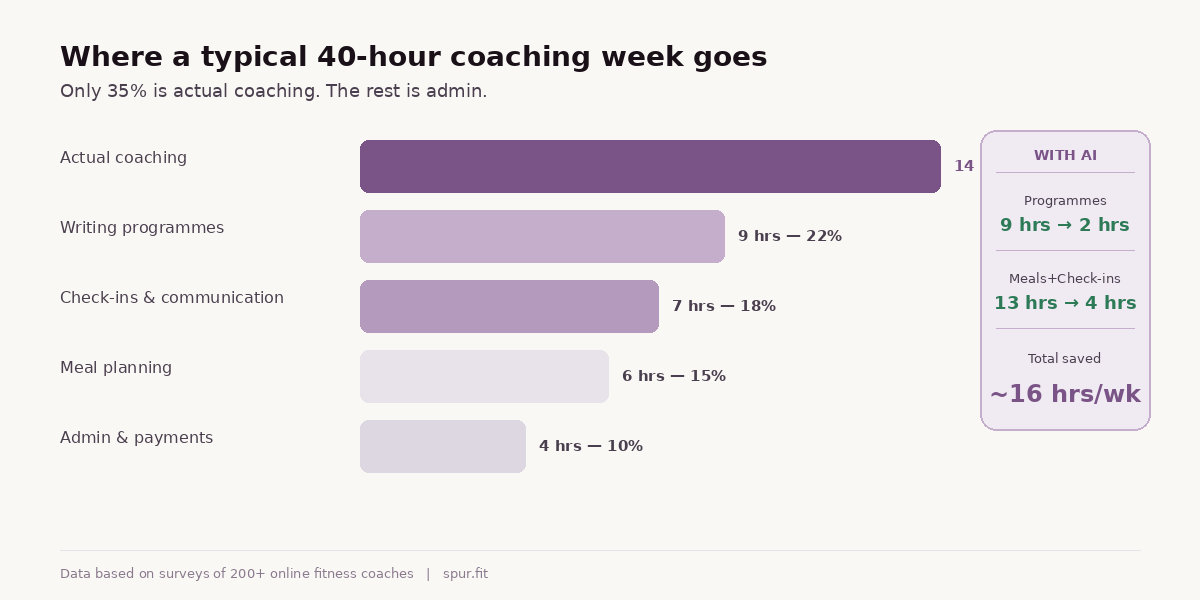
In a typical 40-hour coaching week, only 14 hours is spent on actual coaching. The rest is admin.
Ask any online coach where most of their weekly hours go and you'll hear the same answer: writing and updating training programmes. A single well-designed 12-week plan for one client can take 4–6 hours to build from scratch. Multiply that by a growing client roster and it becomes unsustainable fast.
AI changes the equation completely. Instead of starting from a blank page, a coach can generate a full periodised programme — split, sets, reps, progression logic, exercise substitutions — in under two minutes. The coach's job shifts from writing to reviewing: checking it fits the client, adjusting for injuries or preferences, and adding their coaching voice.
That shift alone typically saves 6–8 hours a week for coaches with 15+ clients.
Before diving into solutions, it helps to see the problem in plain numbers. In a typical 40-hour coaching week, only around 14 hours (35%) is spent on actual coaching. The rest disappears into:
With AI handling programme writing and meal plans, those 22 hours of non-coaching work collapse to around 6–7 hours. That's 15+ hours reclaimed every single week.
Here's what the time savings look like broken down by task:
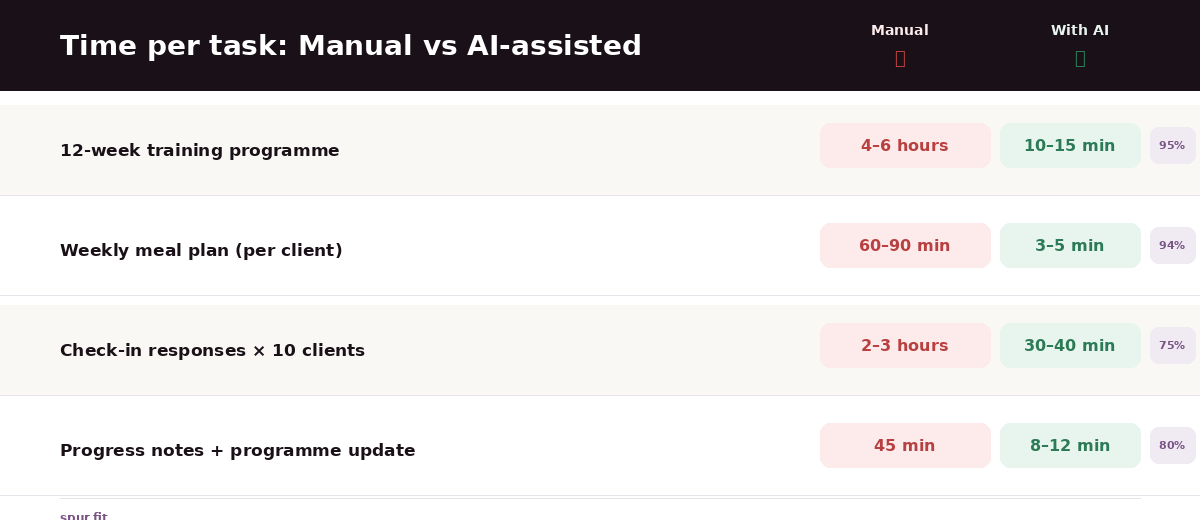
Across the four most time-consuming coaching tasks, AI reduces time spent by 75–95%.
Check-ins are the heartbeat of online coaching. Done well, they keep clients accountable, catch problems early, and make clients feel genuinely supported. Done manually, they're also one of the biggest time sinks in the business.
When a coach has 20 clients, each submitting a weekly check-in with training notes, energy levels, nutrition feedback, and photos, that's potentially 20 individual responses to write. If each one takes 8–10 minutes, that's 3 hours gone every Monday morning — before any actual coaching happens.
AI-assisted check-in tools read the client's submission, flag anything significant (poor sleep patterns, stalling progress, missed sessions), and draft a response the coach can personalise in seconds. The coach's voice stays front and centre; the AI just handles the heavy lifting of structure and first draft.
Nutrition coaching is a huge differentiator for online coaches — clients who get meal plans alongside their training programmes stick around longer and get better results. But building a genuinely personalised meal plan used to take 60–90 minutes per client.
AI meal plan generators have changed this completely. Input the client's stats, goals, restrictions, and preferences; get a complete weekly plan in under 5 minutes. The coach reviews it, swaps anything that doesn't fit, and sends it. Clients get a fully personalised plan. The coach spent 8 minutes instead of 90.
Scaled across a 20-client roster, that's the difference between meal planning taking half a day or taking one hour.
This is what makes AI genuinely transformational for coaching businesses rather than just a minor convenience. Without AI, every new client you take on adds roughly 2–3 hours of weekly admin. At 30 clients you're drowning. At 40 clients it's impossible without a team.
With AI, the admin curve stays nearly flat. Each new client adds maybe 30–40 minutes of weekly time, mostly from actual coaching interactions. That's how solo coaches are managing 30–40 clients without burning out or sacrificing quality.
This is the question that matters. Ten hours a week reclaimed from admin isn't just "less stress" — it's a compounding business asset.
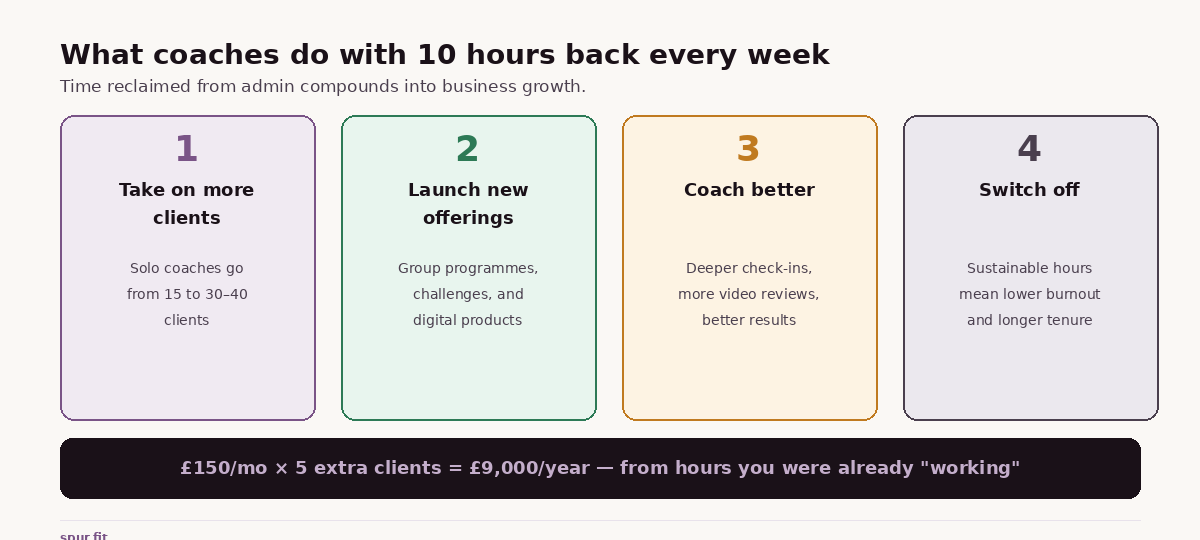
£150/month × 5 extra clients = £9,000/year — from hours you were already "working".
If you're charging £150/month per client and those 10 hours help you take on 5 more clients, that's £750/month — £9,000/year — from time you were already "working" but getting nothing productive done.
Spurfit is built around one core idea: every hour a coach spends on admin is an hour not spent coaching. The platform handles the full operational stack — AI workout generation, AI meal plans, automated check-ins, progress tracking, client messaging, and payments — in a single place.
There's no stitching together five tools. No manual data entry between apps. No spreadsheet updating. The AI generates; you review and personalise; the platform delivers to clients through a branded app that looks like yours.
Coaches using Spurfit consistently report saving 8–12 hours per week. The ones with larger rosters save more.
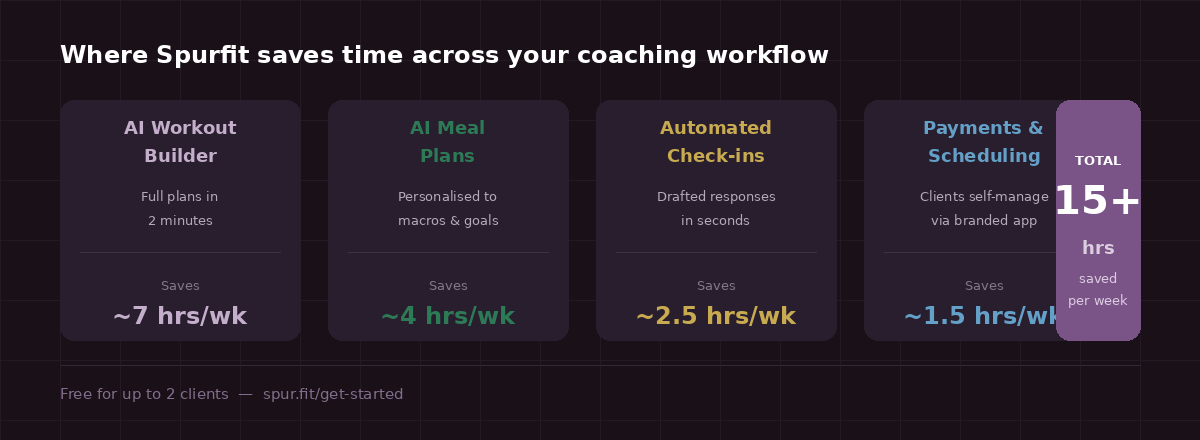
Spurfit coaches consistently report saving 15+ hours per week across the platform.
Here's where the time adds up:
Total: 15+ hours saved per week, per coach.
Start free at spur.fit/get-started — no credit card needed →
Will clients notice the difference between AI-generated and hand-written programmes?
Only in a good way. AI-generated plans that have been reviewed and personalised by a coach are typically more structured and consistent than hand-written ones produced under time pressure. The difference clients notice is that they get their programme faster and with fewer errors.
Does using AI make me less of a "real" coach?
Using a calculator doesn't make you less of an accountant. The expertise is in knowing what to programme, how to progress a client, and how to adapt when things aren't working. AI handles the formatting and first draft. The coaching judgement remains entirely yours.
How long does it take to set up AI tools in my coaching workflow?
With Spurfit, most coaches are generating their first AI programme within 10 minutes of signing up. The learning curve is minimal — if you can describe a client's goals and limitations, the AI can build the plan. Onboarding existing clients typically takes an afternoon.
Is Spurfit only for large coaching businesses?
Spurfit is free for up to 2 clients, making it genuinely useful from day one. The time savings are proportional — even at 5 clients, AI programme generation saves 3–4 hours a week that you can put into client acquisition or simply having a life outside work.
What's the difference between Spurfit and just using ChatGPT?
ChatGPT can write a generic workout. Spurfit builds a periodised programme based on your client's specific profile, integrates with their wearables, delivers it inside a branded app, tracks their progress, and automates their check-in — all connected. It's a coaching operating system, not a chatbot.