How to Scale Your Online Fitness Coaching: From 10 to 30 Clients
Online Client Training

SPUR.FIT

February 11, 2026
How to Scale Your Online Fitness Coaching: From 10 to 30 Clients
Online Client TrainingSPUR.FIT
February 11, 2026
You've hit 10 clients. That's not luck — it means your coaching works, people are willing to pay for it, and you have real proof. Most coaches never get there.
But here's what nobody tells you: the skills that got you to 10 clients will actively hold you back from getting to 30. At 10, hustle and personal outreach carry you. At 30, you need systems, positioning, and leverage.
This guide covers exactly what needs to change — and in what order.
Before you touch your marketing, look hard at who's already paying you.
Ask yourself:
Your answers reveal your real niche — not the one you assumed when you started. One coach I know thought her niche was "strength training for women." Her client data told a different story: she was exceptional specifically with women returning to fitness after injury. When she updated her messaging to reflect that, her consultation conversion rate doubled in 60 days.
This is the most important step. Every other strategy in this guide becomes more effective when your positioning is sharp.

Once you know who your best clients are, update your core message to reflect actual results — not promises.
A strong positioning statement at this stage sounds like:
"I help former athletes rebuild strength after injury using a 3-phase return-to-training system. Most clients are back to pain-free training within 8 weeks."
Notice what makes this work: a specific person, a specific problem, a specific process, a specific timeframe. This is only possible because you've coached real people and seen real outcomes.
Update this across your website, social bios, and consultation opening.
With a validated offer and sharp positioning, you can now invest in lead generation that builds over time — not just one-off outreach.
Content that converts at this stage:
One strength coach created a simple YouTube series called "Form Fix Fridays" answering common technique questions. No paid promotion. Within six months it generated 15 new inbound client inquiries.
Paid ads: With a proven offer, $300–500/month on Meta ads targeting lookalike audiences based on your best clients can generate 5–10 quality leads monthly — if your ad addresses a specific pain point and leads somewhere valuable.
Email: Still the highest-converting channel when used well. Build your list with a free resource that solves a real problem (a 7-day challenge, a meal plan template, a training guide). Then nurture with a sequence that shares client results, addresses common objections, and makes a clear offer. One postpartum fitness coach built a list of 600 subscribers with a single lead magnet — her 8% conversion rate turned that into 48 new clients.
At 10 clients, most coaches rely on free-form discovery calls. At 30, that doesn't scale.
Build a structured sales pathway:
A simple follow-up sequence:
This alone can lift your close rate by 20–30% with prospects who initially hesitate.

This is where most coaches hit a wall. They get the clients — then burn out trying to manually manage everything.
Template-based personalisation: Create 3–4 core programme templates for your most common client types. Personalise 20–30% for each individual. You maintain quality without starting from scratch every time.
Group coaching tiers: Cluster clients with similar goals into semi-private groups sharing resources and check-ins. This is how you serve 30 clients with the time you currently spend on 10.
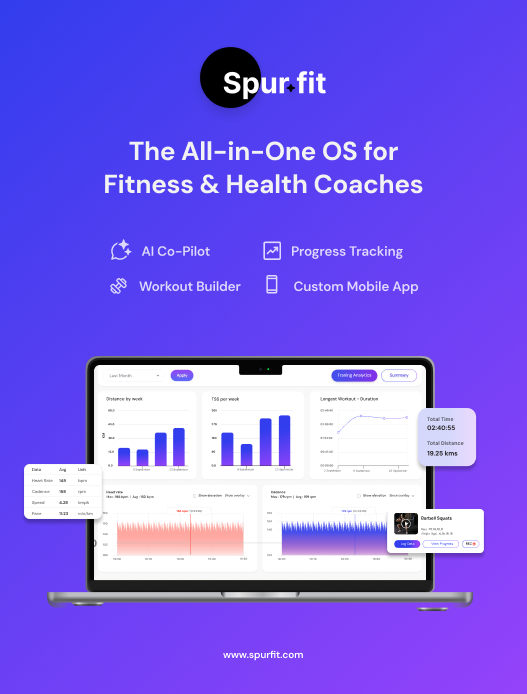
Automate the admin: Client check-ins, progress tracking, nutrition guidance, scheduling, and payments should not be manual processes at this stage. The right coaching platform can handle all of this — saving 15+ hours a week that you can put back into actual coaching or growth.
This is exactly what Spurfit is built for. AI-generated workout and meal plans, automated check-ins, client progress tracking, integrated payments, and a branded app — all in one place. Start free — no credit card needed →
Most coaches with focused execution get there in 6–9 months, adding 2–4 new clients per month. Trying to grow faster than that typically leads to quality problems and churn that undoes the progress.
The opposite is usually right. You now have proof of results. That increases your value. Many coaches successfully raise prices 10–15% after reaching 10 clients and find it actually improves conversion — because it signals confidence and filters for serious clients.
Quality at scale comes from systems, not from working harder. Standardise assessments, check-in cadence, and progression frameworks. Document your methodology. Use technology for tracking and delivery. Consistent systems actually improve client experience — they don't dilute it.
If you're building toward a team or agency model, bring in part-time support for admin and onboarding around 15–20 clients. If you're staying solo, invest in the right tools instead. Either works — trying to do everything manually without systems is what creates the ceiling.
The shift from 10 to 30 clients is really a shift in identity: from a coach who has a business, to a business owner who coaches. The ones who make it don't work three times harder. They build smarter systems, sharpen their positioning, and use the right tools to deliver great coaching at scale.